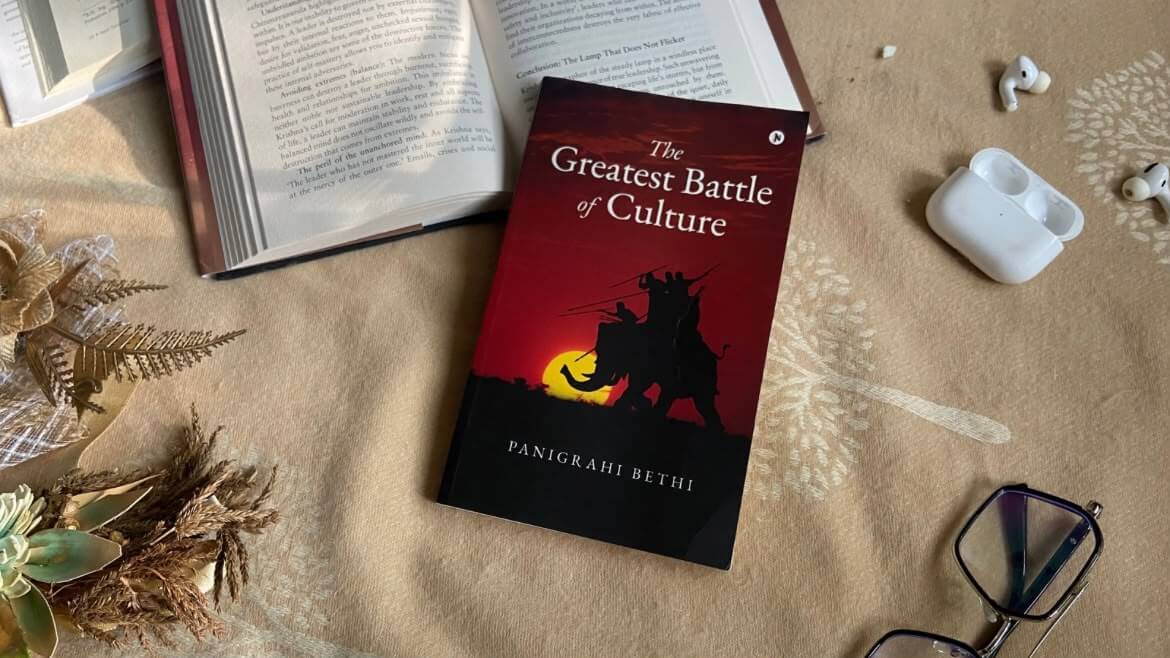
A quote from The Greatest Battle of Culture by Bethi Panigrahi and one that beautifully captures the larger question at the heart of this fascinating historical fiction.
May we continue to learn from each other’s traditions and wisdom. May our love for the divine be the guiding light that illuminates our path, and may we always remember the unity and shared humanity that binds us all.
What is the Greatest Battle of Culture about?
The story takes us back to ancient India, to a time when the Indus Valley Civilization was flourishing with remarkable cities, rich traditions, and a culture far ahead of its time.
Into this world arrives Purusha, a young Aryan warrior who enters a Harappan palace with an unusual proposition.He wishes to share Vedic knowledge in exchange for access to the riches of the Harappan city. When the chief refuses, Purusha returns with two fellow warriors, Ashwin and Varuna, hoping this time to find a way to bridge the two cultures to learn from one another and perhaps coexist.
But the Harappans, aware of the deceptive intentions of the Aryans, ask them to leave peacefully.
Will the Aryans succeed in their attempts and achieve what they came for? Or will the Harappans manage to protect their land, culture and traditions from an outside force?
The struggle for identity
The Greatest Battle of Culture is a fast paced narrative about people, cultures and civilizations struggling to preserve their identity while trying to establish their own superiority. Through an imaginative retelling of a fascinating period in history, the author explores how cultures emerge, evolve and, eventually, disappear with time.
What stayed with me most was the mystery surrounding the Indus Valley Civilization. A civilization that could engineer sophisticated cities, construct elaborate drainage systems and standardise bricks. Yet left behind a script that we still cannot decipher. That contrast alone makes the world of the book incredibly intriguing.
The story is easy to follow, with vivid descriptions of the heritage, beliefs and traditions carried by its characters. Beneath the battles and conflicts lies a deeper story. A of love, loss, identity and the struggle to preserve one’s culture when confronted by another.
At nearly 160 pages, this is a surprisingly compact read. But one that leaves you with far more questions than you started with.
And perhaps that is what makes it memorable.
One of the best works of historical fiction I have read so far. Not merely because of the story it tells, but because of the questions it leaves behind. Questions about culture, civilization, coexistence and the many chapters of history that remain unwritten.
Have any thoughts?
Share your reaction or leave a quick response — we’d love to hear what you think!
-
 0
0 -
 0
0 -
 0
0 -
 0
0 -
 0
0 -
 0
0