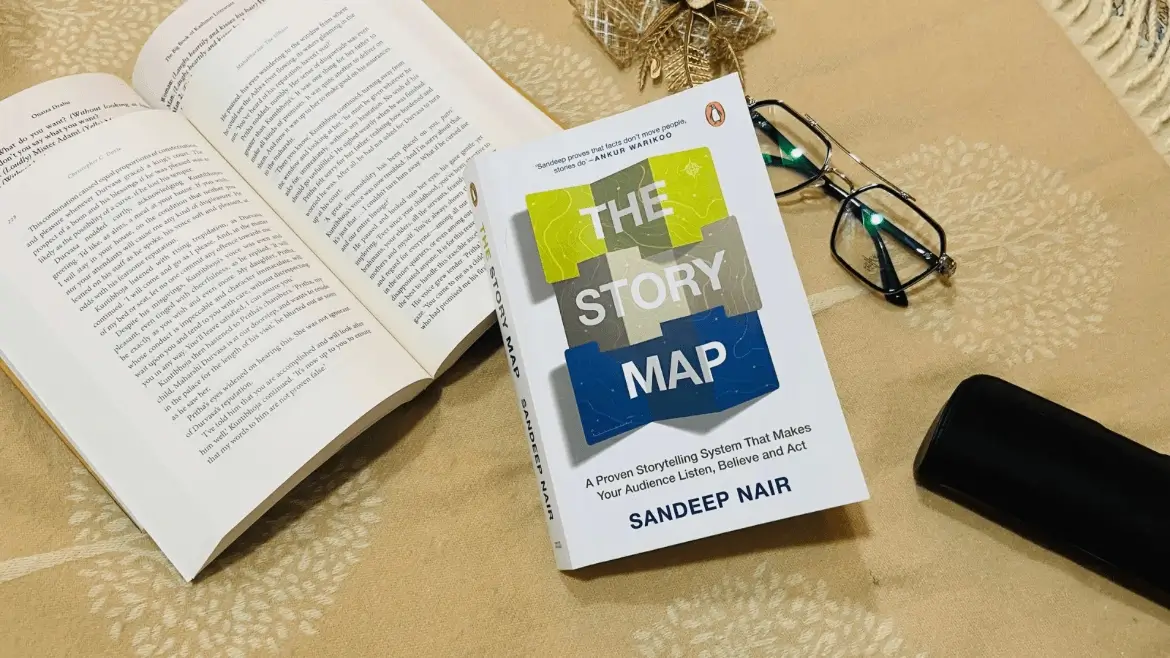
What is The Story Map about?
We all have stories that we have probably heard somewhere, read somewhere, or perhaps even tried to narrate ourselves. But have you noticed that not all stories grab attention or find an audience? Some hook people, while others are simply ignored. And it’s not necessarily because the story is boring. But because it hasn’t been put together in a way that travels or speaks to the audience. This is where a story Map serves it’s purpose.
People often believe that storytelling is an art. Which is gifted and comes naturally to certain people. But the fact is, it is a practised art and a technique that can be learned.
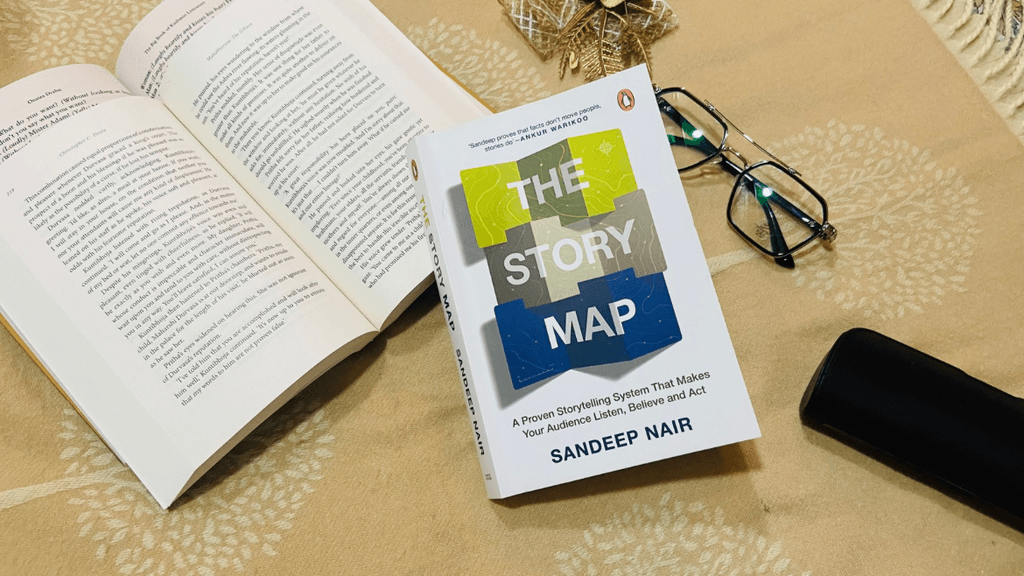
The Story Map by Sandeep Nair is a practical guide to storytelling, built from fifteen years of experience that has actually worked professionally and delivered results. The author says that although storytelling is a technique, you don’t have to start with the technique—and that is a very common mistake most of us make. Instead, he says, start with what you are trying to accomplish.
The Chesire Cat Had a Point
The best example he gives to explain this is Alice in Alice’s Adventures in Wonderland, when she doesn’t have a clue which way she should be going. The Cheshire Cat’s reply might have sounded funny, but it was actually quite right.
“Would you tell me, please, which way I ought to go from here?”
“That depends a good deal on where you want to get to,” said the Cat.
—Lewis Carroll, Alice’s Adventures in Wonderland
A Clear Structure for Storytelling
The structure the author has laid out for storytelling is remarkably clear to follow. As his first step, he believes that every story has a purpose and an audience, and finding those takes you to the story path ahead. He has defined seven missions that cover nearly every situation. Once your mission is clear, you define the soul, give the story its body and structure, use tactics that keep the flow going, and finally create the connection through spirit.
When you follow these five in order, you have a bony structure which, when filled with the right details, becomes a solid story.
What Makes The Story Map Different?
This Story Map is easy to understand, but when practised consistently, it can surely help you become a better storyteller. The examples in the book, based on different missions, further add a layer of understanding of how story-building works in different scenarios.
How The Story Map Changed the Way I Write Reviews
For someone who writes book reviews frequently, I have found myself lost many a time. But when I started reading this book, I began to have a clearer idea of how to approach writing reviews, regardless of the genre. Because, let’s be honest, not every genre is meant for every reader. Knowing that there is a structured path to follow helps build a better review. The Story Map has certainly made that clearer for me.
Who Should Read The Story Map?
What I particularly liked about the author’s approach is that he makes storytelling feel learnable rather than intimidating. Before reading this book, one might feel overwhelmed by the idea of storytelling. But once you comprehend the structure, it feels doable. The framework also helps connect storytelling with real-world communication.
This book should be a great addition for people working with brands, content, or ideas. It can be useful for writers, marketers, entrepreneurs, and professionals who regularly present ideas. And most importantly, for people who think, “Storytelling is not my cup of tea.”
I would even go a step further and say that this book should be part of academic learning. specially when creative writing is taught in schools. A clear understanding of how storytelling works could help students learn and use language more effectively from a young age.
My Takeaway from The Story Map
I now have a clearer idea of storytelling with this structure. Which is definitely going to be applied to my book reviews, blog posts, social media content. And even when communicating an idea more clearly.
Storytelling is not an inbuilt skill. It is about learning how to put the ideas you already have into a flow and structure that makes them travel.
Have any thoughts?
Share your reaction or leave a quick response — we’d love to hear what you think!
-
 0
0 -
 0
0 -
 0
0 -
 0
0 -
 0
0 -
 0
0