
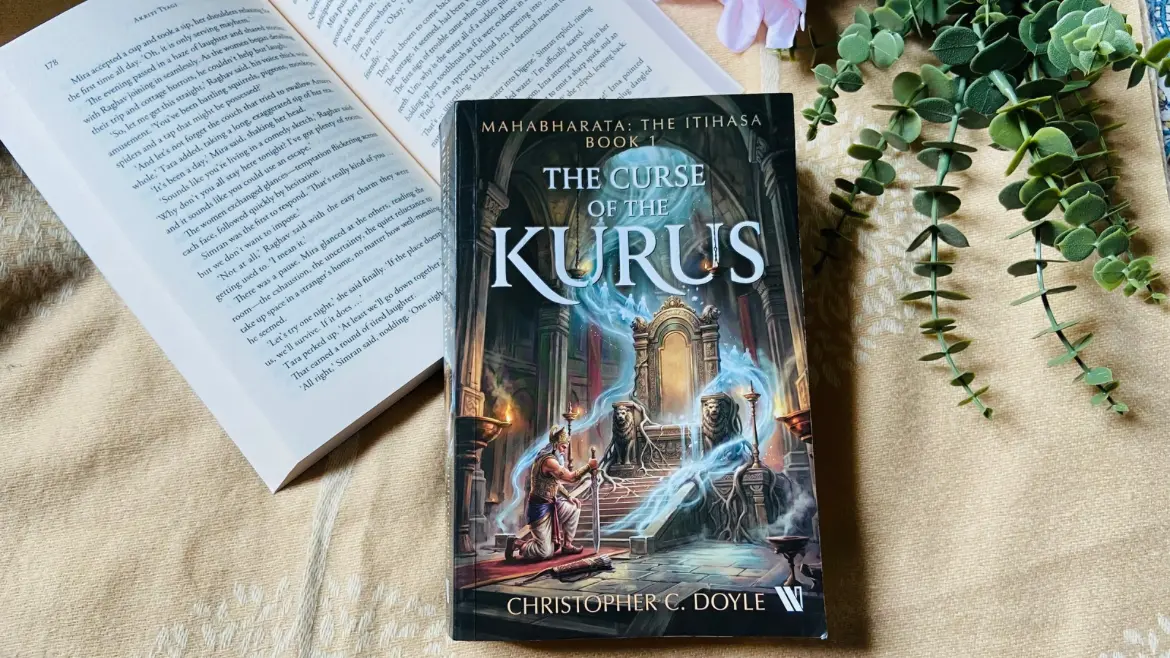
A Fresh Starting Point to the Mahabharata
For someone like me, who hasn’t truly understood the Mahabharata in its entirety, The Curse of the Kurus feels like a fresh and interesting starting point. One that sparks curiosity right from page one.
The Curse of the Kurus happens to be the first book in the Series Mahabharata : The Itihasa related to the great epic that I have read. Until now, I have mostly followed the story through television adaptations or through the lessons and insights our elders shared during family debates and heated arguments.
Growing up, the only retelling of the Mahabharata I truly enjoyed was the one that aired on Star Plus in 2013. However, despite being familiar with the broad storyline, I have never really understood where the epic’s story takes root or how it all began. That part of the Mahabharata has always remained a mystery to me.
Retellings and a Different Approach
Readers enjoy retellings these days, and why wouldn’t they? There is something fascinating about revisiting a familiar story through a different perspective. Sometimes, it is the characters that draw us in; at other times, it is the storyline itself and the curiosity to discover what lies beneath what we already know.
As much as I enjoy retellings that explore the Mahabharata through the perspective of a particular character, The Curse of the Kurus by Christopher C. Doyle takes a different route. It remains firmly rooted in the original narrative, but instead of simply retelling the familiar story, it takes us back to a fresh starting point, allowing the events, characters, and stories that might otherwise go unnoticed to receive the attention they deserve.
Going Back to the Roots of an Epic
The narrative moves back and forth between kingdoms, gradually weaving together the threads that eventually lead to the Mahabharata. The story begins much earlier, and the events that connect it directly to the epic are still some distance away. Yet, this slow unfolding is what makes the approach interesting. Rather than presenting a familiar plot through an entirely new lens, Doyle allows us to witness its foundations taking shape.
It is much like watching a seed take root and germinate, allowing it the time to grow before its branches spread far and wide, bearing the fruits whose stories we have come to know.
Of course, taking creative liberties with a retelling allows an author to shape the narrative around a particular character or perspective. But going back to the roots of an epic as vast as the Mahabharata, researching its lesser-explored corners, tracing the connections between events, and bringing them together into a coherent narrative for readers requires considerable time and effort.
And that is where Christopher C. Doyle deserves appreciation. He retains the essence of the original storyline while giving it a fresh point of entry, allowing us to look beyond the familiar events and pay attention to the foundations on which the epic rests. With The Curse of the Kurus, he offers readers an opportunity not merely to revisit the Mahabharata but to explore how its story began to take shape. For someone like me, who has always known fragments of the epic but never truly understood its beginnings, this approach makes the journey all the more intriguing.
The Storyline: Where the Curses Begin
The story begins with Dyau, one of the eight Vasus, stealing Nandini, the divine cow whose milk was believed to possess the power to preserve youth. He does so at the request of his wife, who wishes to gift the cow to her friend, Jitvati. The only problem? Nandini belongs to Maharshi Vashishtha. Enraged by the theft, the sage curses the Vasus to be born as mortal men on Bhulok
The Curse That Sets Events in Motion
The curse is not merely a starting point but becomes central to the unfolding narrative, shaping the characters’ destinies and setting into motion a chain of events that eventually lays the foundation for the Mahabharata.
With this as the backdrop, the narrative takes two distinct yet eventually interconnected routes. One leads us to the Kuru kingdom, where King Shantanu and Ganga have their own curse to fulfil. Their curse can only be lifted when Shantanu finally loses his composure and questions Ganga’s actions. This makes the story of their eight sons all the more intriguing.
Bound by his promise never to question her, Shantanu watches as Ganga abandons their first seven sons. However, when she is about to do the same with their eighth son, he can no longer contain himself and confronts her. This is where the curses begin to unfold, and honestly, I was completely gripped by the storyline.
Satyavati and the Interconnected Storyline
The other thread takes us to a fisherman who discovers two infant children inside a fish—something that, of course, belongs to the realm of mythology rather than ordinary reality! The boy is adopted by King Vasu, while the girl is raised by the fisherman. This girl is Satyavati, whose life eventually intersects with that of King Shantanu.
How do these seemingly unrelated events come together? That is where the narrative becomes intriguing. The stories are intricately interwoven, and when the connections finally become clear, you begin to understand why certain events had to unfold the way they did. What initially seems like a collection of separate incidents gradually reveals a larger design, making the journey of discovering these connections all the more satisfying.
The Characters and Their Circumstances
As I kept reading, I grew increasingly curious about how the different storylines would eventually converge. I found myself looking forward to discovering the origins of characters I had previously known only by name. Satyavati, for instance, was no longer just the woman who would become instrumental in shaping the Kuru dynasty; understanding her beginnings made me curious about the chain of events that would eventually connect her to Shantanu.
Understanding Bhishma Beyond the Familiar Story
I was particularly impressed by Bhishma’s character and found myself sympathising with the circumstances that shaped his life. Knowing what led him to take that difficult vow made me look beyond the formidable figure I had known through television. His willingness to sacrifice his own future and personal happiness for the sake of his father’s happiness made me reflect on the weight of the choice he made. It is one thing to know about Bhishma’s vow, but quite another to understand the circumstances that led him to make it.
And that is what makes exploring the origins of these characters so rewarding. Familiar names begin to acquire greater meaning when we understand the events, relationships, and choices that shaped their destinies.
The Writing Style
The author presents this great epic in simple, accessible language that is easy to follow, without overwhelming readers with complex mythological terminology that can often make such narratives difficult to absorb. This makes the book approachable even for readers who, like me, may not be well-versed in the origins and intricacies of the Mahabharata.
Final Thoughts
The Curse of the Kurus offers a different way to approach an epic that has been retold countless times. Rather than relying solely on familiar characters and events, it takes readers further back, allowing them to explore the foundations on which the larger story rests.
Have any thoughts?
Share your reaction or leave a quick response — we’d love to hear what you think!
-
 0
-
 0
-
 0
-
 0
-
 0
-
 0