
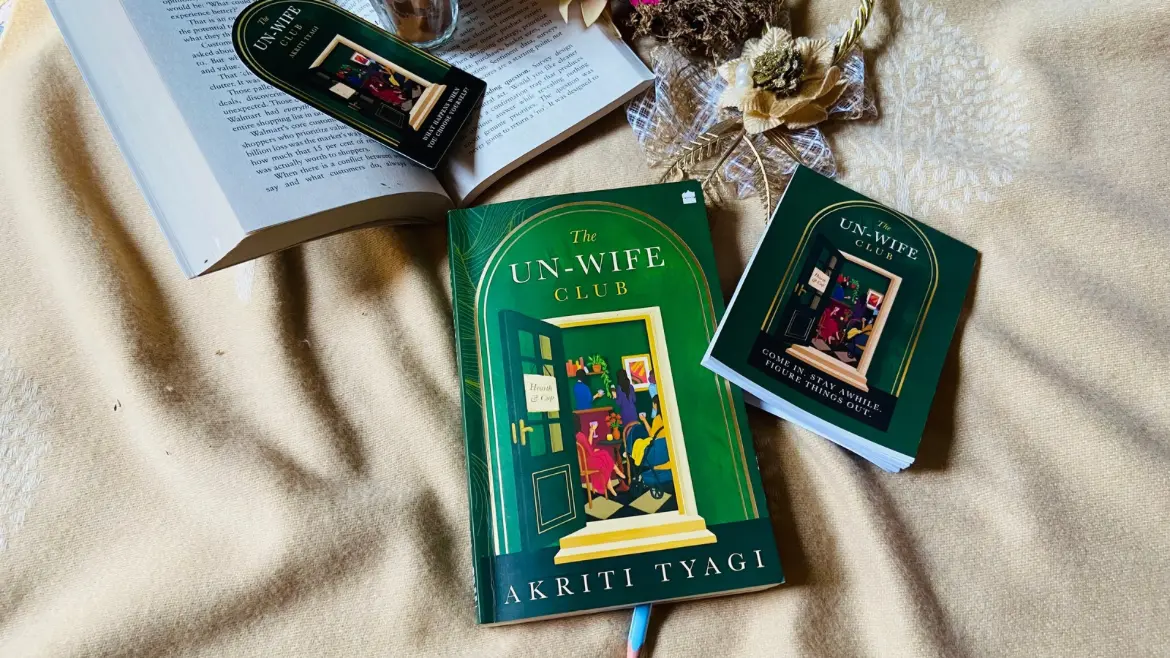
Women have long been part of kitty parties or Clubs. They gather every month, dress to impress, flaunt the gifts their spouses bought them, exchange vacation stories, talk about shopping sprees, offer advice and indulge in a little bragging here and there. But what if there were a club where women showed up not to impress one another, but simply to be there for one another? A space where they could talk openly about troubled relationships, career struggles, family expectations, motherhood and everything else life throws their way. A place without the fear of being judged or the pressure to pretend that everything is fine. I haven’t come across a club like this in the real world yet. But The Unwife Club by Akriti Tyagi brings this idea to life in a way that feels remarkably real and honest.
The story follows five women Mira, Tara, Simran, Amaya and Izna whose lives take different turns as they navigate troubled marriages and the loneliness that comes with them. Their paths gradually cross at Mira’s cafe, where conversations bring their individual struggles into the open.
Although each woman has her own story, they begin to recognise something familiar in one another. It is the feeling of navigating life’s mess without always having someone who truly understands.
The Unwife Club: Five Women, Five Different Stories
The five women are fighting very different battles within their marriages. That is what makes their stories worth exploring.
Mira has to deal with her husband’s infidelity. Simran finds herself caught between her career ambitions and a partner who wishes for a more settled family life. Izna faces the painful reality of abuse and domestic violence. Tara’s success, instead of being celebrated by her husband, is met with insecurity. Meanwhile, Amaya finds herself alone during her pregnancy because her husband never wanted a child.
Their circumstances are different, but each story raises questions about what happens when a marriage stops being the partnership one hoped it would be.
Can love survive when trust is broken? Can two people find common ground when their ideas of a fulfilling life are so different? Why should a woman’s success become a source of insecurity for her partner? And what happens when a woman faces one of life’s most significant transitions without the support she had hoped for?
These are not identical struggles, nor should they be viewed through the same lens. Infidelity, domestic violence, conflicting life goals and the absence of emotional support carry different consequences. Yet each woman must find her way through a life that looks very different from what she might once have imagined.
One thing I particularly appreciated was that all five storylines receive equal attention. Each woman gets the space to share her struggles, and her story is not overshadowed by someone else’s. This allows us to understand their individual circumstances rather than see them merely as five women brought together by a common situation.
Women’s Friendship and Finding Comfort in the Unwife Club
As the women begin sharing their experiences, they realise they are not alone in their struggles. Their conversations eventually lead to the formation of the Unwife Club, a space where they can show up as they are, speak honestly and find comfort in being heard.
The Unwife Club is not a club anyone wishes to join. None of these women would have imagined themselves arriving at this point in their lives, trying to make sense of relationships and circumstances that didn’t turn out the way they had hoped.
Yet there they are, brought together by life’s unexpected turns.
They are not necessarily there because they have figured everything out, but because they are trying to. Together, they navigate the chaos, search for a little peace and discover strength in different forms. Sometimes it comes through a conversation. Sometimes, it comes from being understood. And sometimes, it is simply the knowledge that they don’t have to face everything alone.
But the club is not just about sharing struggles or having someone to lean on when life gets difficult. It is also about finding ways to live a little more, even while battling circumstances that are far from ideal.
Unanniversary: Choosing Yourself
Celebrating a New Chapter
The idea of an unanniversary feels particularly meaningful. Unlike an anniversary that celebrates the beginning of a marriage, it celebrates the day these women chose themselves.
Through this celebration, they find a reason to mark a turning point in their lives. Not with regret for what didn’t work out, but with an acknowledgement of the women they are becoming.
Making Vows to Themselves
Writing vows to themselves makes this moment even more meaningful.
We often associate vows with promises made to another person. But how often do we pause to make promises to ourselves? Promises to honour our needs, protect our peace, recognise our worth and not lose ourselves while trying to make a relationship work.
For these women, the unanniversary is not about dismissing their past or pretending their struggles no longer matter. It is about acknowledging that their lives do not end where a marriage does.
There is still room for hope, laughter, new beginnings and the possibility of discovering parts of themselves they may have set aside along the way.
Sometimes, choosing oneself begins with a promise to stop abandoning oneself for the sake of keeping someone else happy. These women, by writing vows to themselves, turn that promise into something worth celebrating.
The Writing Style and Twists in The Unwife Club
Beyond the women’s individual struggles and the friendships they build, the book has its share of unexpected turns.
A stranger who frequently visits Mira’s cafe, and who appears to have some connection to her husband, Vikram, introduces an element of curiosity and intrigue. Who is this person, and how does he fit into Mira’s life?
This thread adds another layer to the narrative. It reminds us that even when we think we understand a person’s circumstances, there may be pieces of the story we haven’t yet uncovered.
Conversational Writing and Smooth Pacing
The writing is conversational and natural, blending emotion with wit and, at times, humour. The pacing flows smoothly, giving the characters room to unfold their stories without making the narrative feel unnecessarily dragged out.
The heavier emotional moments are balanced with lighter, comforting ones. These offer the reader a chance to breathe before moving forward. This balance keeps the book engaging without making it emotionally overwhelming.
My Review of The Unwife Club by Akriti Tyagi
I enjoyed the way each of these women eventually finds closure in their relationship and moves towards a new chapter in life.
While I found the overall journey satisfying, Tara’s storyline felt a little unsettling and less convincing to me. Although I had anticipated the direction it might take, I was still hoping that something in those final moments would change my understanding of it. Somehow, I was left wanting a little more from her story.
Despite this, I thoroughly enjoyed the book. In fact, I finished it in just two sittings, in a rare stretch of time when nothing demanded my attention except the women of the Unwife Club and their lives.
A Personal Connection: Reading This Book in My 40s
As a woman navigating her 40s, I found something deeply relatable about The Unwife Club.
It made me think of women like these who might be living somewhere around us, carrying their struggles quietly, yet rarely finding a space where they can speak about them openly. I have seen women in such circumstances withdraw from society, perhaps out of fear of being judged or having their choices questioned.
What I had never really imagined was a space like the Unwife Club, where women could come together, share their experiences and discover that life could still hold possibilities beyond relationships that didn’t work out.
The book made me wonder how many such women are out there, living quietly in a society that can be quick to judge, when all they might need is a place where they feel understood and free to begin again.
Sitting in Mira’s Cafe: A Reading Experience to Remember
The experience of reading the book was so immersive that it felt as though I were sitting in Mira’s cafe, quietly watching these women share their stories, navigate their struggles, laugh together and slowly find their way forward.
And somewhere in that imagined space, I could simply sit and breathe, without feeling the need to do anything more.
As the book puts it, “You can just sit. Breathe. That counts too.”
Perhaps that is what the Unwife Club truly represents. A space where you don’t always need answers or solutions. Where your presence is enough, and where being heard and understood can be a comfort in itself.
For those hours, I wasn’t merely reading about these women. I felt as though I was right there with them, sharing the quiet comfort of a place where simply being was enough.
Some clubs bring women together to share what they have. The Unwife Club brings them together to share what they are going through.
And perhaps that is the kind of gathering many women could do with, a space where they don’t have to put on a brave face, explain every decision or pretend to have it all together.
After all, life doesn’t always follow the plans we make for ourselves. But perhaps, somewhere along the way, we find people who help us make sense of the life we actually have.
If you enjoy stories centred on relationships but prefer a lighter, more humorous take, you can also read my review of Blame It On The Wedding Season.
Have any thoughts?
Share your reaction or leave a quick response — we’d love to hear what you think!
-
 0
-
 0
-
 0
-
 0
-
 0
-
 0