
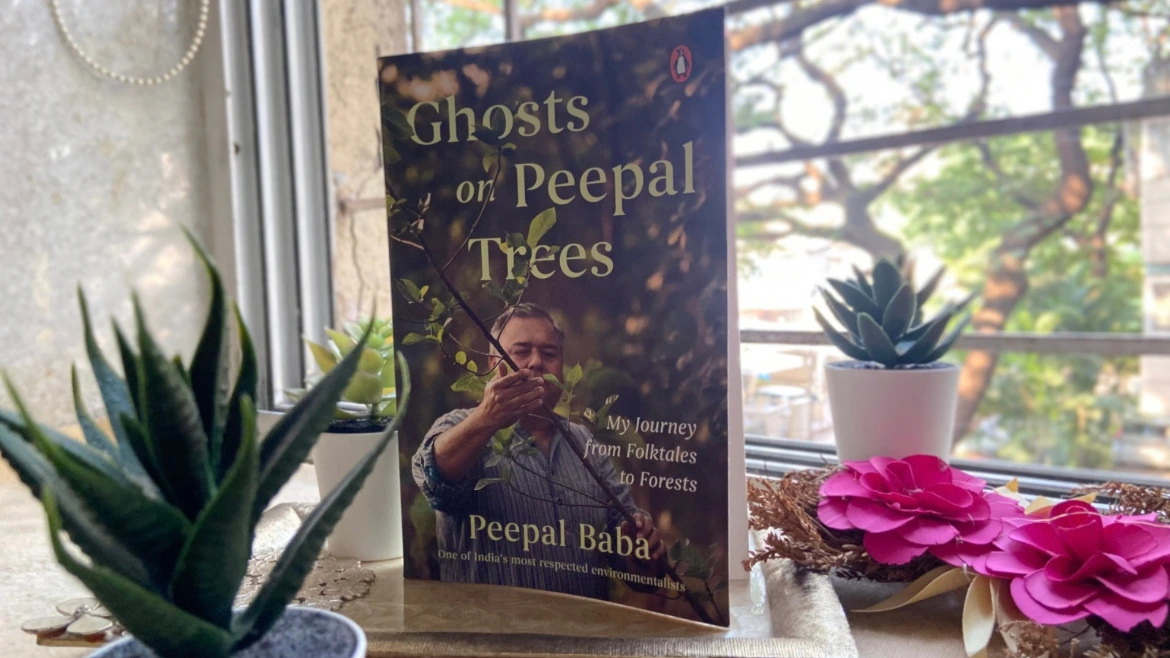
What is Ghosts on Peepal trees about?
What if ghosts could be angels, superstition could be protection, and faith could be as practical as a hand on your shoulder?
These are some of the contradictions Ghosts on Peepal Trees made me pause and think about. The book is the memoir of environmentalist Swami Prem Parivartan, popularly known as Peepal Baba. Whose lifelong contribution to planting and nurturing trees has earned him several titles along the way
The memoir takes us into Peepal Baba’s early years in Dehradun and Pune. Where he seemed to belong more to the outdoors than to the classroom. His grandmother’s rituals became his first lessons in fieldwork. Teaching him, perhaps without intending to, to observe and respect the natural world around him. These lessons were later complemented by his primary school teacher, Mrs Williams. Who introduced him to another way of looking at nature and responsibility.
What began with a homework assignment from Mrs Williams, under the name “Give Me Trees,” would eventually grow far beyond the classroom. That simple school exercise would, years later, become the foundation for something much larger bringing together faith, community and a deep-rooted commitment to planting trees.
When the Soil becomes the Soul
One idea from the book that particularly made me think in depth was that ,”Soil is the soul of everything.” We have learned how civilisations have flourished or fallen depending on the soil beneath them, yet we often overlook the quiet role it plays in sustaining life.
Learn to feel the ground
What will stay with me the most, though, is Granny’s wisdom hidden in everyday rituals and Mrs Williams’ words: “Learn to feel the ground. Knowledge begins with touch.” There is something profound about that thought. Before we learn to measure, analyse or explain nature, perhaps we need to learn to simply feel it
More than Ghosts on trees
The title may make you think this is a book about ghosts living on trees. But beneath that intriguing premise lies something much deeper the idea that belief, culture and community can sometimes become unexpected ways of protecting nature.
The memoir takes us through the many places Peepal Baba travelled and the people and experiences he encountered along the way. What struck me was the simplicity of his approach. His acts of care were devotional, without any expectation of recognition or a particular outcome. He didn’t set out to persuade people or ask them to follow him. He simply continued doing what he believed was right.
Perhaps that is what makes his story so compelling. When care is genuine, it doesn’t always need a name or an invitation. Sometimes, it simply takes root and grows.
The memoir itself is simple to follow, divided into small chapters that draw from his handwritten notes and reflections. There is something fitting about this format. The book, much like his acts of care, remains quiet and unassuming. It never feels preachy. Instead, it allows the stories and observations to speak for themselves.
If you enjoy memoirs with a larger purpose, stories rooted in Indian culture, or books that explore nature, trees and conservation through personal experiences, this one might resonate with you. And if you particularly enjoy life stories where a sense of purpose develops organically rather than being deliberately pursued, Ghosts on Peepal Trees is worth finding your way to.
Have any thoughts?
Share your reaction or leave a quick response — we’d love to hear what you think!
-
 0
0 -
 0
0 -
 0
0 -
 0
0 -
 0
0 -
 0
0